Fire safety is one of the most important considerations in modern construction.
For shopping malls, hotels, hospitals, office buildings, airports, and industrial facilities, protecting occupants and reducing the spread of fire are essential parts of building design.
While fire alarms and sprinkler systems are commonly recognised, another important part of fire safety often remains hidden within the structure: passive fire protection.
Passive fire protection systems help maintain the fire resistance of walls, floors, and other building elements. Firestop systems are particularly important because they protect openings and joints that could otherwise allow fire and smoke to spread between compartments.
For commercial construction projects in Oman, correct firestop planning is an important part of creating safer, more reliable buildings.
1. What Is Passive Fire Protection?
Passive fire protection refers to building materials and systems designed to resist or limit the spread of fire and smoke without requiring activation.
Unlike active fire protection systems such as sprinklers and alarms, passive systems form part of the building’s construction.
Examples include:
- Fire-resistant walls and floors
- Fire-rated doors
- Firestop sealants
- Fire-resistant barriers
- Penetration sealing systems
- Fire-rated joint systems
- Structural fire protection coatings
These systems work together to help maintain fire compartments and provide additional time for evacuation and emergency response.
2. Why Firestop Systems Are Important
Modern buildings contain extensive electrical, plumbing, mechanical, and communication systems.
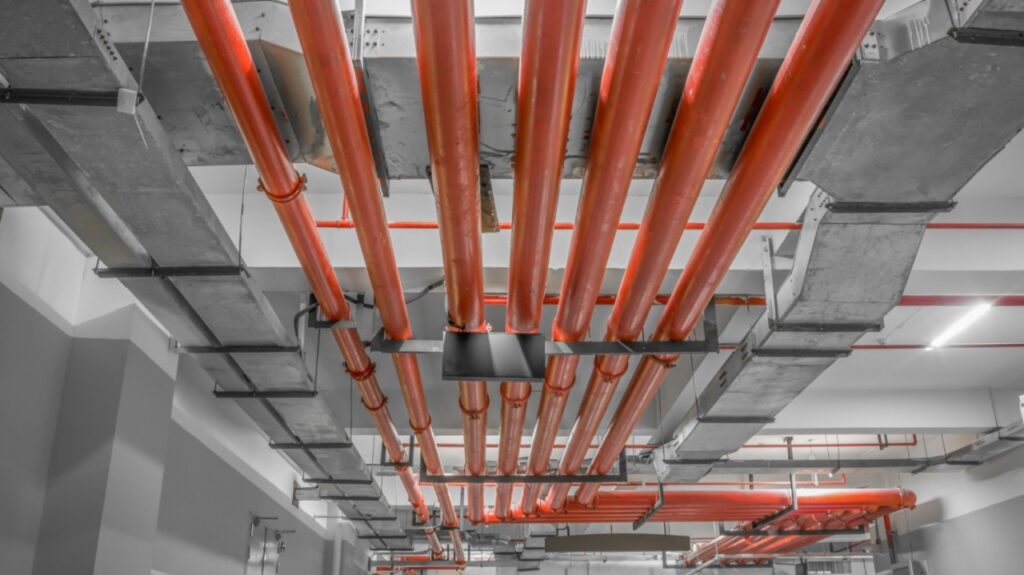
Pipes, cables, ducts, and conduits frequently pass through walls and floors.
These openings can weaken fire separation if they are not correctly protected.
Firestop systems are designed to seal such openings and restore the required fire-resistance performance of the penetrated assembly.
Properly specified and installed firestop systems help:
- Limit the spread of fire
- Reduce smoke migration
- Maintain fire compartmentation
- Protect escape routes
- Support building safety requirements
- Reduce the risk of fire spreading between different areas
Their importance increases in large commercial buildings where services pass through multiple floors and rooms.
3. Firestop Sealants and Their Applications
Firestop sealants are commonly used around service penetrations and fire-rated joints.
They can be applied in approved systems around:
- Electrical cables
- Metal pipes
- Cable conduits
- Mechanical service openings
- Wall and floor penetrations
- Construction joints
Different sealants have different technical properties.
Some are designed to remain flexible, while others form part of systems intended for particular penetration materials and configurations.
The correct product must be selected according to the tested system, required fire rating, and installation conditions.
Using an ordinary construction sealant in place of a specified firestop product can compromise the fire resistance of the assembly.
4. Fire-Rated Joints Need Special Attention
Buildings experience movement caused by temperature changes, structural loads, and other environmental conditions.
Joints between walls, floors, and building sections may need to accommodate movement while maintaining fire resistance.
Fire-rated joint systems are designed for this purpose.
They are especially important in:
- Commercial towers
- Hotels
- Hospitals
- Shopping malls
- Airports
- Large institutional buildings
The joint system must suit the expected movement, joint width, and fire-resistance requirements.
A fire-rated joint is not simply a gap filled with sealant. It is a complete tested system that must be installed correctly.
5. Why Hotels and Hospitals Need Reliable Firestop Systems
Hotels and hospitals require careful fire compartmentation because occupants may be sleeping, unfamiliar with the building, or need assistance during evacuation.
Firestop systems are commonly needed around service penetrations in:
- Guest rooms
- Patient rooms
- Corridors
- Service shafts
- Electrical rooms
- Mechanical rooms
- Floor and wall assemblies
Correctly installed systems help maintain the integrity of the building’s fire-rated compartments.
For hospitals and hospitality projects in Oman, firestop planning should be coordinated early with architectural and MEP designs.
6. Firestop Systems in Shopping Malls and Offices
Large commercial developments contain multiple service networks.
Electrical cables, plumbing, ventilation, and communication systems often pass through different fire compartments.
Without proper firestopping, these openings can become pathways for fire and smoke.
Firestop systems should therefore be considered during:
- Building design
- MEP installation
- Interior fit-outs
- Renovation work
- Facility maintenance
This is particularly important in commercial properties where new cables and services may be added after the original construction is completed.
Whenever a fire-rated wall or floor is penetrated, the fire protection details should be reviewed.
7. Choosing the Right Firestop Materials
Not every firestop product is suitable for every application.
Before selecting a system, project teams should consider:
Fire Resistance Rating
The selected system must meet the required fire-resistance performance for the specific assembly.
Type of Penetration
Different systems may be required for metal pipes, plastic pipes, electrical cables, cable trays, and ducts.
Wall or Floor Construction
The type and thickness of the wall or floor can affect which tested system is appropriate.
Movement Requirements
Fire-rated joints may need to accommodate expansion, contraction, or structural movement.
Installation Requirements
Correct opening dimensions, backing materials, application depth, and installation procedures are essential.
Testing and Documentation
The system should have appropriate test evidence and approvals accepted by the relevant project authority.
Correct specification is more important than simply selecting a product labelled fire-resistant.
8. Installation Quality Makes a Major Difference
Even an approved firestop system may not perform as intended if it is installed incorrectly.
Common installation problems include:
- Incorrect sealant depth
- Poor surface preparation
- Unapproved material substitutions
- Gaps around penetrations
- Incorrect backing materials
- Using products outside their tested configuration
Contractors should follow the manufacturer’s installation instructions and the applicable tested system details.
Inspection and documentation are also important, particularly for large commercial and industrial projects.
9. Firestop Maintenance Should Not Be Ignored
Firestop protection must remain effective throughout the building’s use.
During renovations or maintenance, new electrical and mechanical services may be installed through existing walls and floors.
These changes can disturb previously installed firestop systems.
Building owners and facility managers should ensure that penetrations and joints are inspected when alterations are made.
Damaged or disturbed firestop systems should be repaired using appropriate, approved methods.
Regular attention helps maintain the building’s fire safety strategy over time.
10. Passive Fire Protection Solutions Through Al Amana
Al Amana Building Materials provides access to building protection solutions for different commercial and construction requirements in Oman.
The company’s fire protection product information includes firestopping and related passive fire protection technologies.
Al Amana Building Materials is proud to represent FOSROC, a globally recognised leader in construction chemicals and passive fire protection solutions. FOSROC’s fireproofing and firestopping range, including fire-rated sealants, sealing systems and protective coatings, is engineered to contain fire and smoke and safeguard lives and structures. Trusted on major projects worldwide, FOSROC is known for tested performance, consistent quality and strong technical innovation. Through a long-standing partnership, Al Amana has brought these proven solutions to Oman’s commercial and construction sectors, backed by dependable supply and expert support. Together, we have contributed to many strong, safe and enduring buildings that now stand across the Sultanate.
For architects, consultants, MEP engineers, developers, and contractors, selecting the correct firestop system requires an understanding of the building’s fire-resistance requirements, service penetrations, and installation conditions.
Technical product information and coordination with qualified fire protection professionals are important parts of this process.
From hotels and hospitals to offices, shopping malls, and industrial facilities, the goal is to select systems that support the overall fire safety design of the building.
Final Thoughts
Fire safety is not only about detecting and controlling a fire.
It is also about preventing fire and smoke from spreading rapidly through a building.
Passive fire protection and firestop systems help maintain the integrity of fire-rated walls, floors, joints, and service penetrations.
For commercial projects in Oman, proper firestop planning, tested materials, correct installation, and ongoing maintenance are essential.
The right solution should always be selected according to the building’s technical requirements and applicable fire safety standards.
Because protecting a building means protecting the people inside it
We craft seamless experiences that transform your spaces with high-quality materials and skilled expertise.
Company
Get in touch
- Head Office
- +968 24815080
- Al Amana Home - Showroom
- +968 91106036, +968 99357490
- Landline
- +968 22700146